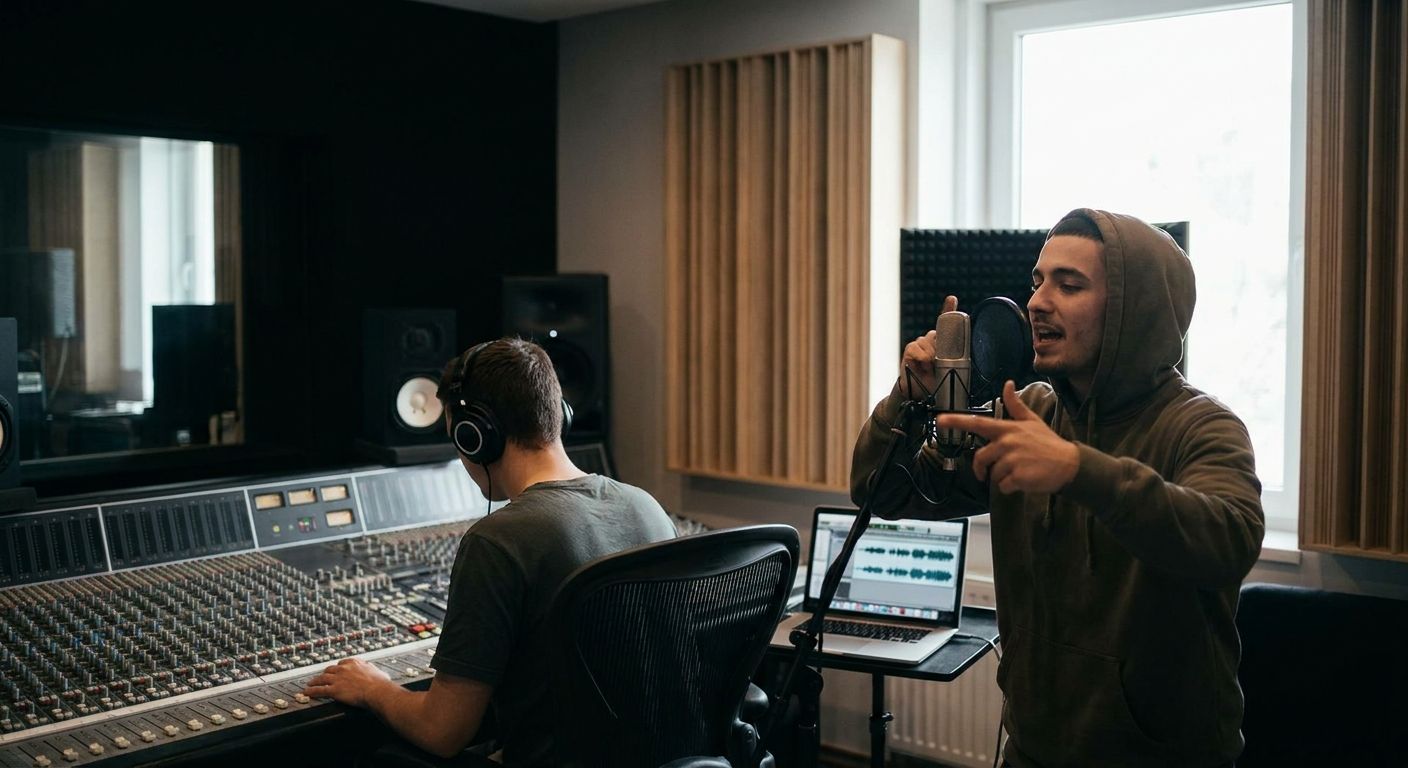
Freestyle rap audio recording is the process of capturing improvised, in-the-moment bars over a beat with a mic chain, room setup, and workflow built for spontaneity instead of a scripted verse. A freestyle session lives or dies on speed and feel — you're not stopping to punch in sixteen times, you're chasing the take that sounds like the idea hit you two seconds before you said it.
- Freestyle rap audio recording favors one-take capture over punch-ins — three punch-ins or more and it's a written verse, not a freestyle.
- Gain staging around -18dBFS at the interface keeps freestyle ad-libs and shouted bars from clipping mid-take.
- A 48kHz/24-bit recording standard is the baseline for 2026 sessions that need to survive mixing and mastering later.
- Boom bap beats for lyrical rappers and trap instrumentals both work for freestyle, but tempo match matters more than genre.
- A producer-led session compresses a full freestyle-to-mixdown cycle that a home setup stretches over days into hours.
Why Audio Recording Matters for Freestyle Rap Artists
Freestylers get judged differently than rappers dropping a polished single. Listeners forgive a stumbled bar if the energy is real, but they won't forgive muddy audio, clipped vocals, or a beat that buries the flow. The technical bar is lower on lyrical perfection and higher on capture quality — because the whole appeal is that nothing was rehearsed.
That changes what you need from a session. You need a mic chain that's forgiving of volume swings (freestylers whisper then scream in the same bar), a beat library deep enough to grab something on the fly, and an engineer or workflow that doesn't slow down the moment. Louie The Producer builds sessions around that reality instead of treating freestyle capture like a studio-album vocal take.
Build Your Freestyle Recording Session Step by Step
Set your mic chain before you touch the booth
A freestyle take is unforgiving — you don't get a second pass at the exact bar that just came out of your head. Dial in the chain before the beat even starts playing.
- Set input gain so your loudest ad-lib peaks around -6dBFS, leaving headroom for shouted bars
- Use a cardioid condenser or dynamic mic depending on room treatment — dynamics forgive untreated rooms better
- Keep mic distance at 6-8 inches to avoid proximity-effect bass buildup on low-register bars
- Turn on a high-pass filter around 80Hz to cut room rumble without touching your vocal body
- Test levels with an actual freestyle warm-up, not a spoken line — energy changes gain needs
Pick a beat that matches your flow, not the trend
Freestylers waste sessions cycling through instrumentals looking for "the one." Match tempo and pocket to how you actually rap, then commit.
- Confirm BPM range fits your natural cadence — most freestyle flows sit comfortably between 130-160 BPM on trap-tempo beats
- Pick sparse arrangements with open pockets so ad-libbed bars don't fight the instrumental
- Test two or three instrumentals max before locking one in — indecision kills freestyle momentum
- Browse boom bap beats for lyrical rappers if your flow leans wordy over a laid-back drum pattern
- Skip anything with a busy hook already baked in — freestyle needs open space, not competing vocals
Warm up your pen and your voice before the beat rolls
A cold freestyle sounds cold. Give yourself ninety seconds of low-stakes rapping before the mic is actually recording.
- Run the beat once with no recording, just to feel the pocket
- Do a 30-second scat freestyle to loosen delivery and breath control
- Write zero bars in advance — reading from notes kills the "freestyle" claim and it's audible
- Pick one word or theme as a loose anchor if you need a starting point, not a written line
Choose your take strategy: punch-in or one-take
This decision shapes the whole session. Freestyle purists run one continuous take; others punch in between 16-bar sections to keep energy fresh across a longer track.
- One-take capture preserves the raw, unedited feel that defines freestyle content
- Punch-ins work for longer freestyle videos (2-4 minutes) where fatigue changes delivery halfway through
- Cap punch-ins at two per session — beyond that, you're editing a written verse, not capturing a freestyle
- Log timestamps as you go so editing later doesn't mean scrubbing a 10-minute file blind
“If you punch in more than three times on a freestyle, it's not a freestyle anymore — it's a written verse with extra steps.”
Track gain staging and levels for a clean take
Freestyle sessions swing loud fast. Riding levels manually during the take protects the recording from clipping without killing energy.
- Keep average levels around -18dBFS at the interface for clean headroom into mixing
- Watch for red clip indicators on shouted ad-libs and pull gain back live if needed
- Record a room-tone reference for 5 seconds before the take starts — useful for noise reduction later
- Use a pop filter regardless of mic type; freestyle plosives hit harder than scripted delivery
Mix a rough pass on the spot before you leave the session
A rough mix before you walk out tells you immediately if the take is usable or if you need another pass.
- Apply a light compressor (3:1 ratio) to tame dynamic swings from freestyle energy shifts
- EQ a high-pass at 80Hz and a small dip around 300-500Hz to clear vocal mud
- Check the mix on phone speakers before ending the session — that's how most people will hear it first
- Bounce a rough reference file immediately so you're not waiting days to know if the take worked
Lock your paperwork and ownership before you release anything
Freestyle content gets uploaded fast, which means ownership questions get skipped fast too. Confirm what you're getting before you drop the track.
- Know whether your beat license lets you monetize the freestyle on platforms like YouTube and TikTok
- Check if you're working with a lease or a full copyright transfer / work-for-hire buyout
- Read the full guide on buying exclusive beats online as an independent rapper before you commit to a beat you'll freestyle over repeatedly
- Save your session files and stems — freestyle takes often get remixed into a fuller song later
Speed up turnaround with a producer-led session
The manual path above works, but it eats time you could spend writing and dropping content. A producer-led freestyle session compresses mic setup, beat selection, and rough-mix turnaround into one sitting instead of a multi-day DIY grind.
- Producer sessions skip the trial-and-error on mic chain and gain staging entirely
- Beat selection happens from a catalog built for freestyle pockets instead of scrolling for an hour
- Rough mixes get handled by someone who mixes freestyle vocals daily, not occasionally
- You leave with a session-ready file instead of a raw take you still have to clean up yourself
Get your freestyle session moving
Grab a beat built for freestyle pockets and book your session.
Comparison: Recording Options for Freestyle Rap Artists
| Option | Best For | Key Limitation |
|---|---|---|
| DIY home setup | Artists testing flow before committing to a session | Untreated rooms and inconsistent gain staging hurt clean capture |
| Local hourly studio | Artists who want in-person energy and instant feedback | Clock pressure can rush a take that needs breathing room |
| Remote/online producer session | Independent artists who need fast turnaround without travel | Requires a decent home mic setup on your end for input quality |
| Live improvised cypher recording | Content built around group freestyle energy | Harder to control individual levels across multiple mics |
Verdict: a producer-led session wins for independent freestyle rappers who need a clean take and a usable rough mix without burning a weekend on setup.
Common Mistakes Freestyle Rappers Make in Sessions
- Writing bars in advance and calling it a freestyle — audiences and engineers can hear the difference in cadence within the first four bars
- Skipping the warm-up entirely — the first 30 seconds of a cold freestyle almost always gets re-recorded anyway
- Ignoring beat licensing terms — uploading a monetized freestyle over a lease that restricts commercial use invites a takedown
- Over-punching a "freestyle" until it's edited into a written verse — defeats the purpose and it's audible in the pacing
- Not logging a rough mix before leaving the session — walking out without checking playback on phone speakers means finding problems days later
FAQ
What's the best way to record a freestyle rap at home?
Set input gain so your loudest ad-lib peaks around -6dBFS, use a high-pass filter near 80Hz, and record at 48kHz/24-bit minimum so the file survives mixing later. A cardioid mic 6-8 inches away handles most untreated home rooms better than a condenser picking up reflections.
Is a producer session better than recording freestyle at home?
A producer-led session is faster because mic chain, beat selection, and rough-mix steps are already dialed in, while a home setup takes trial and error to match that quality. Home recording still works for testing flow before committing to a full session in 2026.
How many takes should a freestyle recording session use?
One continuous take preserves the freestyle feel best, with a maximum of two punch-ins for longer 2-4 minute freestyle videos. More than three punch-ins turns the recording into an edited written verse rather than a freestyle.
Do I own the beat I freestyle over?
Ownership depends on whether you're working with a leased beat or a full copyright transfer / work-for-hire buyout, and that determines what you can monetize. Check the license terms before uploading a freestyle to a platform where it could generate ad revenue.
What BPM works best for freestyle rap?
Most freestyle flows sit comfortably between 130-160 BPM on trap-tempo beats, though boom bap tempos in the 85-95 BPM range suit lyrical, wordier freestyles. Match the beat to your natural cadence instead of chasing whatever tempo is trending.
Should I mix a freestyle recording the same way as a studio track?
A rough mix pass with light compression around 3:1 and a high-pass at 80Hz is enough for freestyle content posted quickly in 2026. Full mixing and mastering makes sense only if the freestyle gets developed into a released song later.
Can I record a freestyle over any trap or hip-hop beat?
Yes, as long as the license permits the use you're planning, whether that's a free upload or a monetized post. Sparse arrangements with open pockets work best for freestyle because they leave room for ad-libbed bars without fighting a busy instrumental.
How long should a freestyle recording session take?
A producer-led session can move from beat selection to a rough mix in a single sitting, while a DIY home session often stretches across multiple days of setup and re-takes. Warm-up time of about 90 seconds before the first real take reduces the number of throwaway takes either way.
One Last Thing
Most freestyle takes get ruined by gain staging, not talent — a bar that clips at -2dBFS is unusable no matter how hard it hit in the moment. Set your levels before the beat drops, not during the first ad-lib, and you'll keep more takes than you throw away in 2026.