
Most independent rap artists know the feeling. You build a fire 8-bar loop, get hyped about it, and then stall out. The beat sits on your hard drive, unfinished, while your catalog stays empty and your career stays stuck. That cycle kills momentum faster than anything else in this game. The good news is that a clear, repeatable beat making process breaks that cycle for good. This tutorial walks you through every stage, from setting up your tools and crafting drums to arranging full songs and exporting finished tracks, so you can build a real catalog and grow your career on your own terms.
Table of Contents
- What you need before starting: Tools, mindset, and beat types
- From vibe to groove: Crafting drums and rhythm
- Building melodies, bass, and samples with movement
- Arrangement and finishing: Turning loops into full songs
- Finishing touches: Exporting, sharing, and iterating for growth
- The uncomfortable truth about finishing beats for independence
- Take your beats further with pro resources
- Frequently asked questions
Key Takeaways
| Point | Details |
|---|---|
| Set BPM first | Choosing your tempo early saves time and aligns all track elements seamlessly. |
| Start with drums | Building a strong groove with humanized drums gives the beat its core feel and energy. |
| Structure beats fully | Arranging beyond simple loops is essential for creating complete, usable tracks. |
| Prioritize finishing | Rapid iteration and export lead to more growth and opportunities than endless tweaking. |
| Mix pragmatically | Basic mixing for clarity is enough at first; release and learn as you go. |
What you need before starting: Tools, mindset, and beat types
Before you touch a single drum pad or piano roll, you need the right setup and the right headspace. Skipping this step is why so many beats never get finished.
Essential tools for beat making:
- DAW (Digital Audio Workstation): FL Studio, Ableton Live, Logic Pro, and GarageBand are the most popular choices. FL Studio is a favorite for trap and hip-hop. Ableton is strong for live performance and sampling workflows.
- Headphones or studio monitors: A solid pair of closed-back headphones works fine to start. Open-back or monitor speakers give you better mix accuracy over time.
- Laptop or desktop computer: Any modern machine with at least 8GB of RAM handles most DAWs without issues.
- MIDI keyboard or pad controller: Not required, but it speeds up melody creation and makes beat programming feel more natural.
- Sample packs and VST plugins: Stock sounds inside your DAW are enough to start. Free packs from sites like Splice or Looperman give you more options fast.
| Tool | Essential | Optional upgrade |
|---|---|---|
| DAW (FL Studio, Ableton) | Yes | Paid version for more features |
| Headphones | Yes | Studio monitor speakers |
| Laptop/desktop | Yes | Audio interface |
| MIDI keyboard | No | Pad controller |
| Sample packs | No | Premium VST plugins |
The mindset piece matters just as much as the gear. Completion beats perfection every time. Your goal at this stage is to build a workflow that gets beats finished, not to craft the perfect instrumental on the first try. Check out practical workflows that help you move faster and stay consistent.
Knowing your beat type before you start also saves time. Tempo ranges for hip-hop are well established: boom bap and head-nodding styles sit at roughly 85 to 95 BPM, modern trap runs between 130 and 150 BPM, and southern or bouncy styles feel best at 70 to 85 BPM.
Pro Tip: Set your BPM before you lay down a single sound. Changing tempo mid-session throws off your sample timing, your loops, and your groove. Lock it in first and build everything around it.
From vibe to groove: Crafting drums and rhythm
With your BPM set and tools ready, the next move is to establish groove and rhythm as the backbone of your beat.
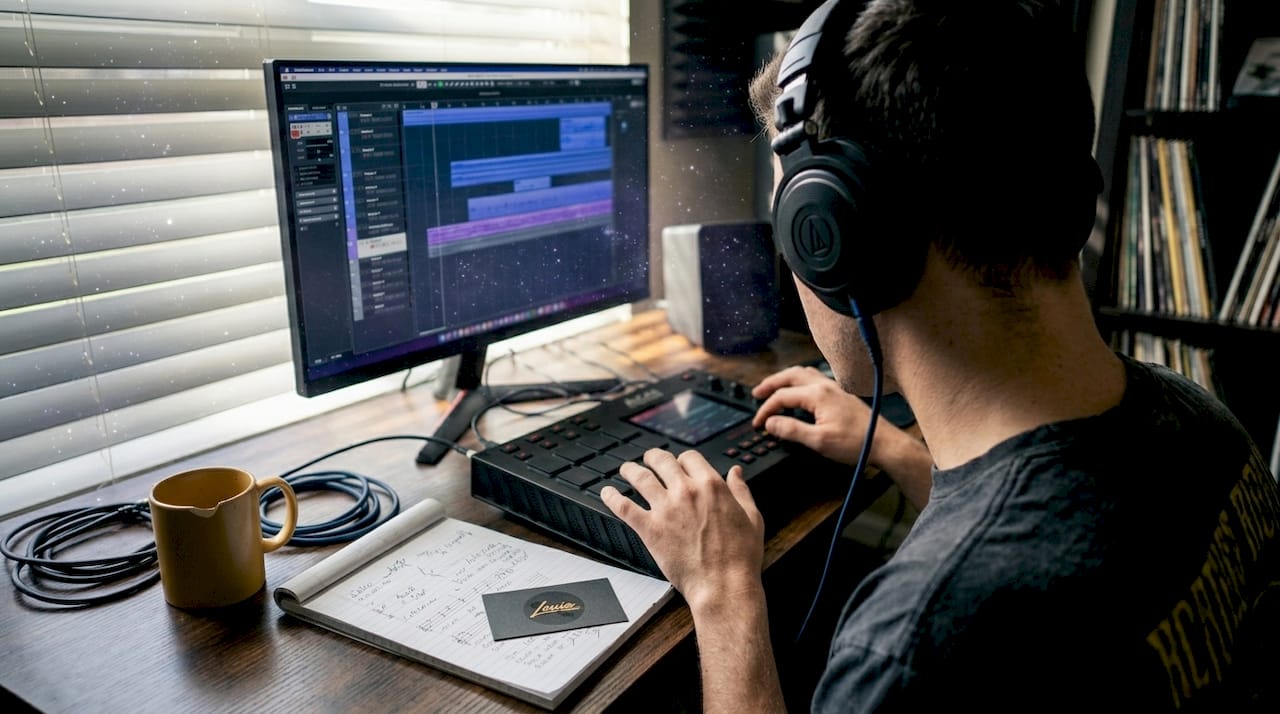
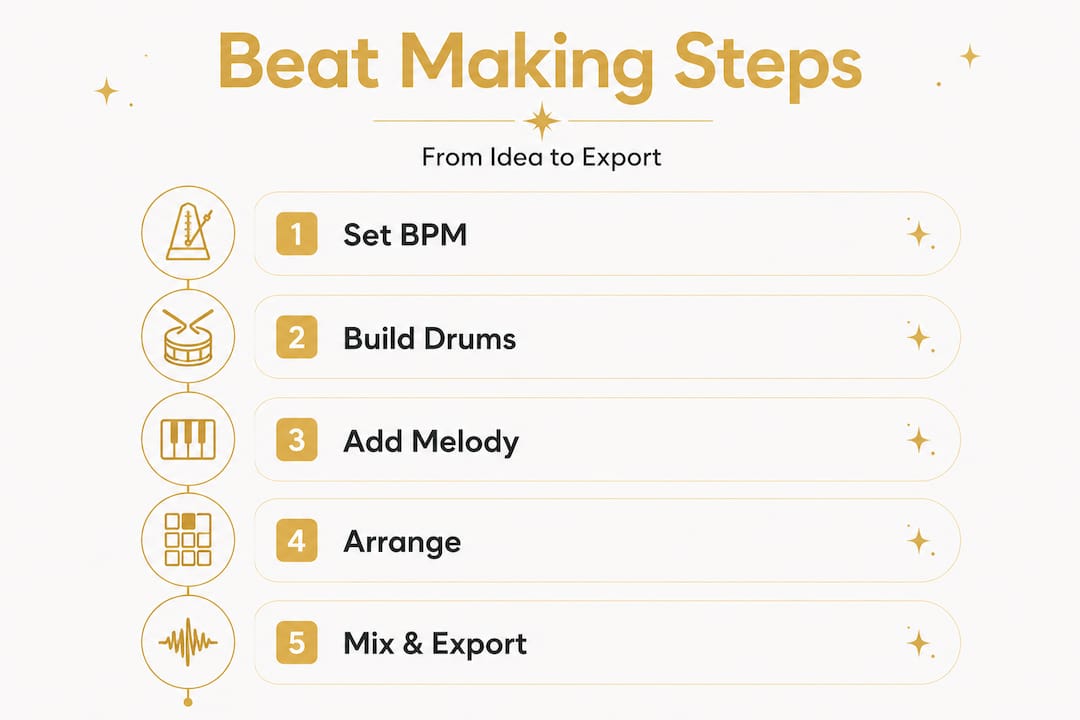
Drums are the foundation. Everything else sits on top of them. A practical beatmaking workflow starts with tempo and vibe, then builds drums first, adds melody and sample layers, locks in the bass with the kick, arranges the loop into a full structure, and finishes with mixing and export. Follow that order and you will finish more beats.
Here is a step-by-step approach to building your drum groove:
- Choose your drum sounds. Pick a kick, snare, and hi-hat that fit your style. Punchy 808 kicks for trap, harder boom bap kicks for classic hip-hop, or layered snares for a thicker sound.
- Lay the kick pattern. For boom bap, kick hits on beats 1 and 3. For trap, kicks are more syncopated and often hit on the "and" of beats.
- Add snare or clap on beats 2 and 4. This is the backbone of nearly every rap beat. Drum programming basics confirm that snare and clap on 2 and 4 drive the rhythm with consistency.
- Program hi-hats. Straight 8th or 16th notes work for boom bap. Trap uses rolls, triplets, and swing-heavy patterns for energy.
- Add percussion layers. Shakers, rimshots, or open hi-hats add texture and keep the groove interesting over multiple bars.
- Humanize your drums. Shift timing slightly off the grid and vary the velocity of each hit. This is what separates stiff, robotic patterns from grooves that actually move people.
"For groove realism, alter timing and velocity, using swing and humanization, for a more natural feel."
You have two main options when building drums. Option A is to start from a pre-made drum loop or sample, slice it up, and rearrange the hits. This is fast and gives you a natural feel right away. Option B is to program every hit yourself for total control over the pattern. Both approaches are valid. Many producers combine them, using a loop as a reference and then replacing individual sounds.
Pro Tip: Layer a live-recorded clap on top of your programmed snare, or dial in subtle swing in your DAW's step sequencer. Even 5 to 10 percent swing can transform a flat pattern into something that grooves hard.
Building melodies, bass, and samples with movement
With your drum groove locked in, it's time to add melodies, bass, and samples to give your beat its soul and energy.
This is where your beat gets its identity. The melody is what listeners remember. The bass is what they feel. Getting both right is what separates average beats from ones that artists want to rap over.
Approaches to building melody:
- Play original melodies using a VST instrument like a piano, synth, or strings. Even simple two or three note patterns can be memorable when placed correctly.
- Chop and layer samples. Find a vinyl record, a royalty-free sample pack, or a cleared sample, slice it into pieces, and rearrange the chops to create something new. This is a classic hip-hop technique.
- Combine both. Use a sample for the main hook melody and layer original synth lines underneath for depth.
A full beatmaking workflow always includes a melody or sample layer added after drums, followed by a bass line that locks with the kick drum. That lock between bass and kick is critical. When your 808 or bass note hits at the same time as the kick, the low end feels tight and powerful. When they clash, the mix sounds muddy and unprofessional.
Tips for making 808s and bass sit right:
- Pitch your 808 to match the key of your melody. An out-of-tune 808 is one of the most common mistakes in independent rap production.
- Keep your 808 and kick from overlapping too long. Side-chain compression or volume automation can duck the kick when the 808 sustains.
- Use a high-pass filter on everything except the bass and kick to clear up low-end mud.
Add ear candy throughout your beat. Small fills before a new section, reverse cymbal swells, vocal chops, or a quick FX hit all add movement and keep listeners engaged. You can explore more rap and hip-hop beats for inspiration on how melody and bass work together in professional productions.
Pro Tip: Use contrast to your advantage. Layer a simple, memorable melody over a complex drum pattern. Or put a busy, chopped-up sample over a minimal kick and snare. Contrast creates tension and interest that makes beats stand out.
Arrangement and finishing: Turning loops into full songs
After adding all musical elements, you need to structure your beat into a finishable product that stands out and supports vocals.
Most independent producers get stuck here. They have a great 8-bar loop and no idea what to do next. Arrangement for hip-hop beats should evolve beyond a single loop by adding a full song structure with intro, verse, chorus, bridge, and outro sections, and using subtraction and dropouts to create vocal space and dynamic contrast.
Here is a reliable arrangement structure for a rap beat:
- Intro (4 to 8 bars): Start with a stripped-down version of your main loop. Maybe just drums and a melody hint. This gives the artist room to set the scene.
- Verse section (16 bars): Bring in the full beat. All elements playing together.
- Chorus or hook (8 bars): Add energy. Thicker bass, more percussion, or a new melodic layer.
- Second verse (16 bars): Return to the verse feel, maybe with a subtle variation.
- Bridge or breakdown (4 to 8 bars): Drop elements out. Create tension before the final section.
- Outro (4 to 8 bars): Fade or strip back down.
"Don't get stuck in tutorial loops. Focus on complete, structured beats for real progress."
Use transitions between sections. A riser effect before the chorus, a drum fill before the verse drops, or a reversed cymbal hit adds professionalism and keeps the energy moving.
| Approach | Pros | Cons | Best practice |
|---|---|---|---|
| Loop-based (8 bars repeated) | Fast, easy to build | Boring for full songs, limits artists | Use as a starting point only |
| Structured arrangement | Professional, artist-ready | Takes more time | Always finish with full structure |
Mixing basics matter here too. Level your elements so nothing is clipping. Pan hi-hats slightly to one side and percussion to the other for width. Use basic EQ to cut low-end mud from non-bass instruments. You do not need a perfect mix at this stage. You need a mix that sounds clean and balanced. Check your finishing practice regularly to sharpen these skills over time.
Finishing touches: Exporting, sharing, and iterating for growth
Once you have arranged and mixed your beat, it is time to wrap up, get it out there, and start reaping the rewards of consistent output.
Here is a final export and sharing checklist:
- Bounce your beat as a WAV file at 44.1kHz, 24-bit for the highest quality master file.
- Export an MP3 version at 320kbps for streaming and sharing on platforms.
- Add metadata. Include your producer name, beat title, BPM, and key in the file tags. This protects your work and makes it searchable.
- Upload to SoundCloud, BeatStars, or your own website to build your portfolio and attract artists.
- Share on social media with a short video clip or visualizer to drive plays and engagement.
The most important stat you need to know is this: finishing more tracks accelerates your improvement faster than any single tutorial or course. Avoiding tutorial loops and instead building complete tracks, from arrangement through export and sharing, and repeating that cycle is what builds real career sustainability as an independent artist. Every finished beat teaches you something a half-done loop never will.
Encourage yourself to iterate. Beat 20 will be better than beat 1. Beat 50 will be better than beat 20. The artists who win without labels are the ones who keep finishing and releasing, not the ones who wait for the perfect track.
The uncomfortable truth about finishing beats for independence
Here is a perspective you will not hear in most tutorials: the biggest threat to your career as an independent rap artist is not bad equipment, not lack of connections, and not even a weak mix. It is the habit of never finishing.
Most producers spend months tweaking the same beat, chasing a sound they heard on a major label release, and convincing themselves it is not ready yet. Meanwhile, artists who are willing to release imperfect but solid work are building audiences, getting feedback, and improving at a rate that perfectionists never match.
Career sustainability without labels comes from finishing and iterating, not from perfecting one track in isolation. The producers who build real businesses are the ones with deep catalogs, not the ones with one flawless beat that nobody has heard.
Think about it this way. Twenty released beats that are 80 percent of your potential teach you more, build more relationships, and generate more income than one beat you spent a year on. Feedback only comes from tracks that are actually out in the world. Motivation only stays alive when you see real results, and real results come from real releases.
Pro Tip: Set a hard deadline for every beat. Give yourself three to five sessions maximum to go from idea to export. Treat each beat as a learning step, not a final statement. Your skills grow through volume and repetition, not through endless refinement.
The independent path is real and it is sustainable. But it requires output. Start finishing. Start releasing. The wins will follow.
Take your beats further with pro resources
Whether you are just starting out or looking for fresh inspiration to push your production skills forward, having access to high-quality beats and professional resources makes a real difference.
At Louie The Producer, we have spent over ten years building a catalog of professional-grade instrumentals designed specifically for independent rap artists. Exploring Exclusive Lease Beats gives you instant access to production that is ready for recording, so you can keep your creative momentum going without getting stuck building from scratch every session. Beyond beats, the platform offers mixing, mastering, and consulting services to help you compete at a professional level from wherever you are. Your next project deserves the right foundation.
Frequently asked questions
What is the best BPM for a rap beat?
Boom bap rap beats work best at 85 to 95 BPM, while modern trap is usually set at 130 to 150 BPM and southern styles at 70 to 85 BPM.
How do I keep my beats from sounding robotic?
Humanize your rhythm by subtly shifting the timing and velocity of your drum hits off the grid. Timing and velocity changes using swing and humanization add groove and a natural feel.
What is the fastest way to finish a beat?
Lay out drums, melody, and bass quickly, arrange a basic structure, and prioritize completion over perfection. Finishing and iterating beats repeatedly is what builds real skills and career momentum.
Should I use samples or compose everything from scratch?
Either approach works well. Use samples for quick, natural-sounding results or compose original parts for more control. Choose whatever fits your creative goals and workflow best.
How important is mixing when making beats as an indie artist?
Basic mixing and EQ balance are crucial for a professional sound, but finishing and releasing beats consistently matters more than chasing a perfect mix at the start of your career.